
Naked and Afraid

Repeat offenders are unsurprising. If someone violates a rule, they are likely to do so again. Repeat victimization however is less self-evident. But the data is overwhelming — if you are a victim once, you are more likely to be a victim again. Especially so in the initial days and weeks that follow your first victimization.
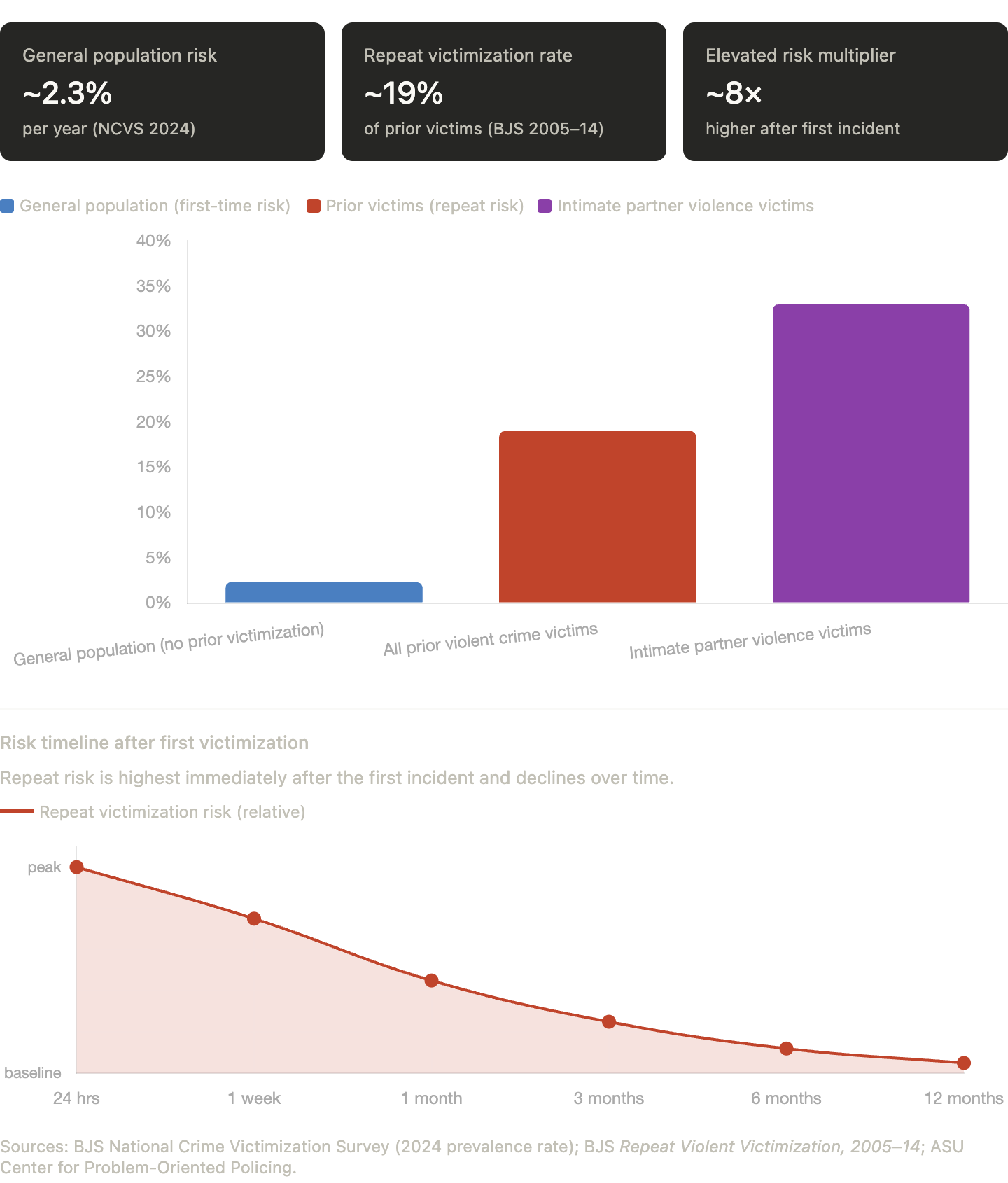
ASU puts it this way:1
Some people are repeatedly victimized and, in conformity with the 80-20 rule, a small proportion of victims account for a large proportion of all victimizations. Ken Pease and Graham Farrell carefully documented this fact in a seminal Home Office publication called "Once Bitten, Twice Bitten". Using British Crime Survey data (see the table), they showed that about 4% of people experience about 40% of all victimizations in one year. They showed that repeat victimization occurs for a variety of crimes including domestic violence, sexual assault, burglary and car-related thefts. They also showed that repeats occur quite quickly, often within a week of the first victimization, though this varies with the offense.
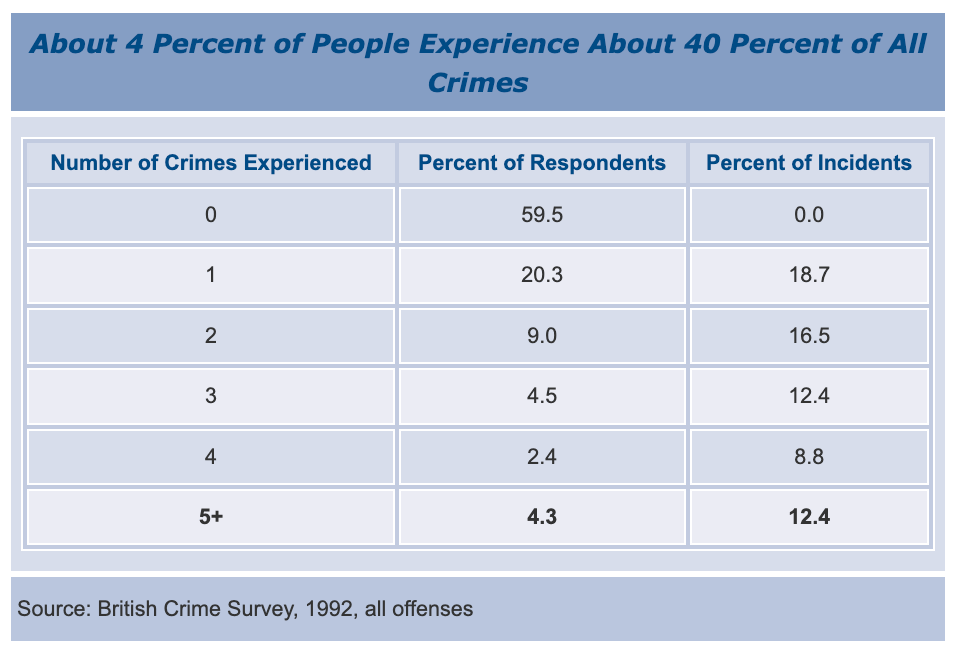
What stands out to me about this quote, is that even seemingly random crimes like car-robbery congregate around a small percentage of people.
Why is this such a universal rule? Why do human systems gravitate towards the mistreatment of certain victims?
Last week we discussed the origin of Joseph, and the false accusation of his brothers. This week we will see that Joseph is a recurring victim. Though he is hundreds of miles away from home, and completely removed from the context of his original persecution, he will face an almost identical set of circumstances.
The Lord was with Joseph, and he became a successful man, and he was in the house of his Egyptian master. His master saw that the Lord was with him and that the Lord caused all that he did to succeed in his hands. So Joseph found favor in his sight and attended him, and he made him overseer of his house and put him in charge of all that he had. From the time that he made him overseer in his house and over all that he had, the Lord blessed the Egyptian’s house for Joseph’s sake; the blessing of the Lord was on all that he had, in house and field. So he left all that he had in Joseph’s charge, and because of him he had no concern about anything but the food he ate.
Genesis 39:2-6a ESV
Once again, Joseph is the favorite and for good reason; he is a man of integrity. Potiphar has entrusted all of his affairs into the hands of Joseph. Joseph is, once again, an object of desire in the economy of a wealthy family. Yet again, this attention and desire does not always yield desired outcomes.
Now Joseph was handsome in form and appearance. And after a time his master’s wife cast her eyes on Joseph and said, “Lie with me.” But he refused and said to his master’s wife, “Behold, because of me my master has no concern about anything in the house, and he has put everything that he has in my charge. He is not greater in this house than I am, nor has he kept back anything from me except you, because you are his wife. How then can I do this great wickedness and sin against God?” And as she spoke to Joseph day after day, he would not listen to her, to lie beside her or to be with her.
Genesis 39:6b-10 ESV
The desire for Joseph has reached a fever pitch yet again, and it has spread to Potiphar’s wife. With his brothers, Joseph was the model for the object of desire: the approval and attention of Jacob. Now, in Potiphar’s house he is the model for the object of divine favor and so is perceived as desirable in the eyes of all. Potiphar’s wife — doubtlessly desirable to be married to such a significant figure — wishes to entrust herself to Joseph. She is the only thing in Potiphar’s house that has not been given freely to Joseph, yet she freely gives herself to him all the same.
Joseph has learned from his past experiences however; he knows that not all gifts are blessings.

Note his objection “Behold, because of me my master has no concern about anything in the house, and he has put everything that he has in my charge. He is not greater in this house than I am, nor has he kept back anything from me except you, because you are his wife. How then can I do this great wickedness and sin against God?”
Joseph recognizes the economy of the home, what is his domain and what is not, and he intuits that great wrath would be incurred upon him should he transgress this boundary with Potiphar’s wife. He does not do this merely in fear of his fellow man however. While he sees the dynamics at play in the economy of the home, he ultimately roots his behavior in higher and first-order principles: what is pleasing in the sight of the Lord.
He recognizes that he is desired, and that this desire is dangerous and potentially disruptive to the entire emotional economy. Most of all, he recognizes this desire could be perilous to his own soul, so he chooses to spurn these desires.
But one day, when he went into the house to do his work and none of the men of the house was there in the house, she caught him by his garment, saying, “Lie with me.” But he left his garment in her hand and fled and got out of the house. And as soon as she saw that he had left his garment in her hand and had fled out of the house, she called to the men of her household and said to them, “See, he has brought among us a Hebrew to laugh at us. He came in to me to lie with me, and I cried out with a loud voice. And as soon as he heard that I lifted up my voice and cried out, he left his garment beside me and fled and got out of the house.” Then she laid up his garment by her until his master came home, and she told him the same story, saying, “The Hebrew servant, whom you have brought among us, came in to me to laugh at me. But as soon as I lifted up my voice and cried, he left his garment beside me and fled out of the house.”
As soon as his master heard the words that his wife spoke to him, “This is the way your servant treated me,” his anger was kindled. And Joseph’s master took him and put him into the prison, the place where the king’s prisoners were confined, and he was there in prison.
Genesis 39:11-20 ESV
Here we have a mirror scene of the brothers’ “murder” of Joseph:
Joseph is betrayed and falsely accused for doing what is right.
His robe is stripped from him
He is no longer called by name, but by a snide and derogatory label. (His brothers called him “this dreamer” Potiphar’s wife calls him “the Hebrew”)
His robe is used to construct a twisted narrative — one intended to erase him from the community at large and alleviate suspicions from his persecutors.
The cloak and the false report is brought to the head of the house, resulting in Joseph’s “death” in the eyes of the patriarch.
Potiphar’s wife is anxious in this scene, as evidenced by her drawing out the “scene of the crime” until her husbands return. She leans into the theatrical in hopes of convincing her husband and dissuading his wrath. (He is evidently powerful — able to throw Joseph into the Pharaoh’s prison). Joseph’s brothers were equally fueled by their angst.
She desired the removal of his cloak, but did not get the desired outcome — she is locked-out of her desired object. Just as Joseph’s brothers desired to remove his cloak, but did not get the desired outcome.
This brings us back to our original question: how can it be that Joseph has been victimized twice in near identical scenarios?
The same thing which makes Joseph successful makes him vulnerable: his integrity. He does not conform to the desires and fears of the familial system, rather he chooses to earnestly seek what is in the best interest of all. This makes him an object of collective desire, and so puts him at risk of resentment and violence. His excellence makes him utterly exposed — for better or worse — which is why he is always losing his robe.
To put it simply, his righteousness invites persecution.2
This is an inescapable thing; living righteously yields mistreatment. Joseph is admirable because, though he has tangibly experienced the cost of doing good, he persists in excellence all the same. He does not go to Egypt, choosing to blend in as part of the crowd. He willingly stands out, even though he fully comprehends the risks.
But Joseph does not merely persist in doing good, he learns the art of self-concealment without losing purity of spirit — he learns how to keep his cloak. He gains hard fought wisdom via his persecution and is transformed into someone who is unrecognizable, even by his family.
This is the only path for the righteous, to be persecuted, slain, resurrected, and transformed. In coming weeks we will see Joseph’s transformation and his radical change in strategy.
Clarke, Ronald V., and John E. Eck. "Step 29: Be Ready for Repeat Victimization." In Crime Analysis for Problem Solvers in 60 Small Steps. Center for Problem-Oriented Policing, Arizona State University, 2016. https://popcenter.asu.edu/sites/g/files/litvpz3631/files/learning/60Steps/index04e6-2.html?stepNum=29.
For you fellow nerds who are familiar with Girard, you will recognize this is a significant departure from his framework. I lean heavily on the work and genius of Girard, his work on desire and persecution is foundational for my entire understanding of this story and I could not write this series without having read him. However, I strongly disagree with Girard on one major point of his framework: his insistence on the utter randomness of victims. For Girard, the scapegoat selection mechanism had to be completely arbitrary in order for it to have any effect. He is wrong. The persecutors must see no logic to the selection process for the scapegoat. They do not perceive the scapegoat as the scapegoat, they perceive the scapegoat as vile and so cannot even recognize that they are innocent and were selected by the crowd. Girard insistence on treating all text’s equally blinded him to the unique insights of the Scriptures — victims are never random. If anything scripture tells us exactly what I have stated above: the righteous are the ones which are persecuted. Why would our Savior call persecution blessed if the basis of it is random? No there must be something intrinsic to the victim of persecution in order for the persecuted to be blessed.
Astute analysis, sir. Thank you for this.